
The three rules
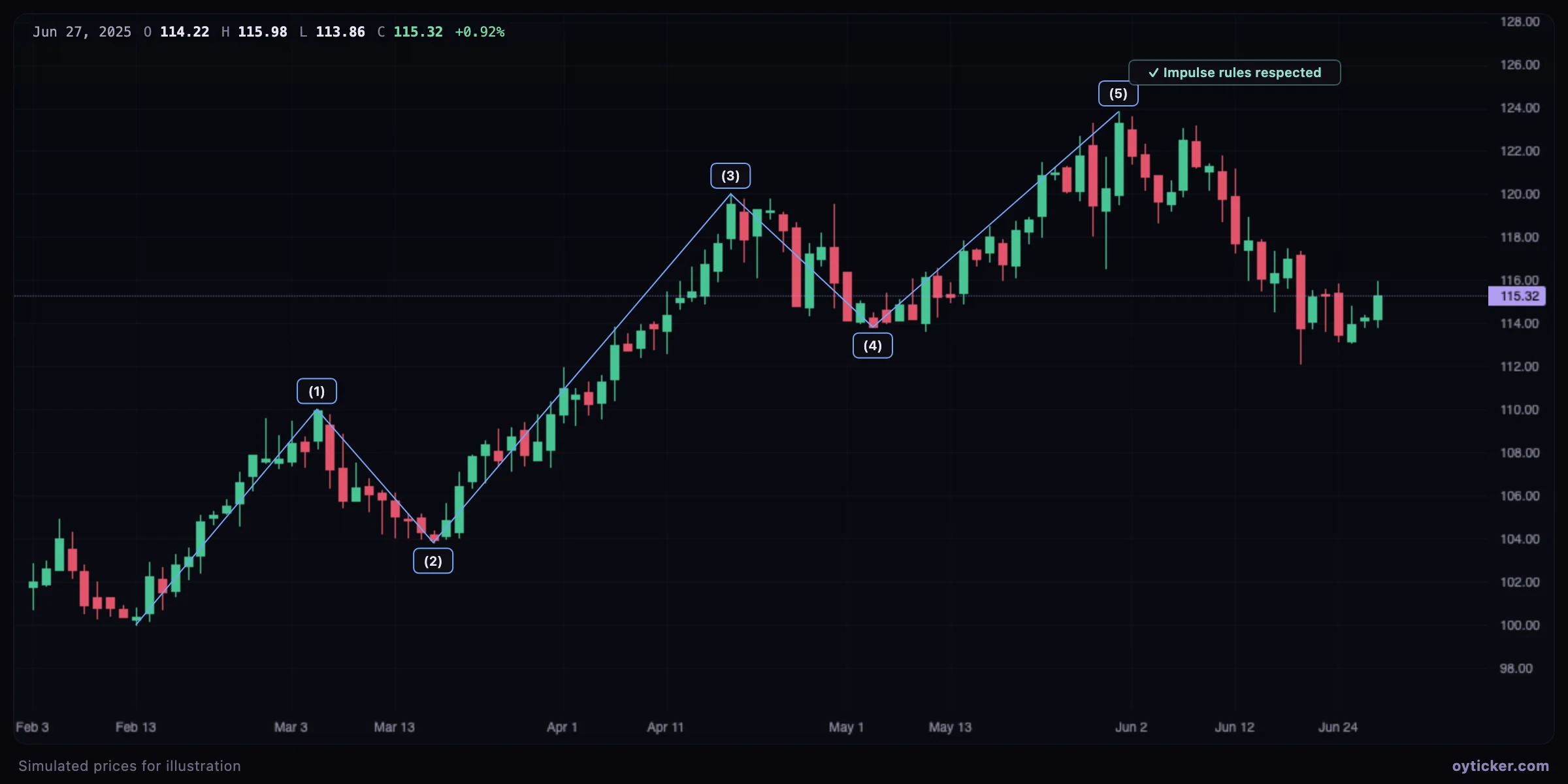
- Wave 2 never retraces more than 100% of wave 1 (it stays above the start of wave 1 in an advance).
- Wave 3 is never the shortest of waves 1, 3 and 5 (in price).
- Wave 4 does not enter the price territory of wave 1 (it stays above the top of wave 1 in an advance). The exception is the diagonal triangle, a special pattern found in waves 1, 5 or C.
Oyticker also checks that the points alternate (each wave goes in the opposite direction of the previous one). A count that breaks a rule is not an impulse: either the labels are wrong or the structure is a correction.
Guidelines (tendencies, not rules)
| Wave | Typical behavior |
|---|---|
| 2 | Deep: often 50% to 61.8% of wave 1 |
| 3 | Often the longest and strongest, frequently around 1.618 × wave 1 |
| 4 | Shallower: often 23.6% to 38.2% of wave 3; alternates in form with wave 2 (sharp vs sideways) |
| 5 | Often equal to wave 1, or 0.618 of waves 1 to 3 |
These relationships help choose between alternative counts; they are not part of the definition of an impulse.
Case study: a count that breaks a rule
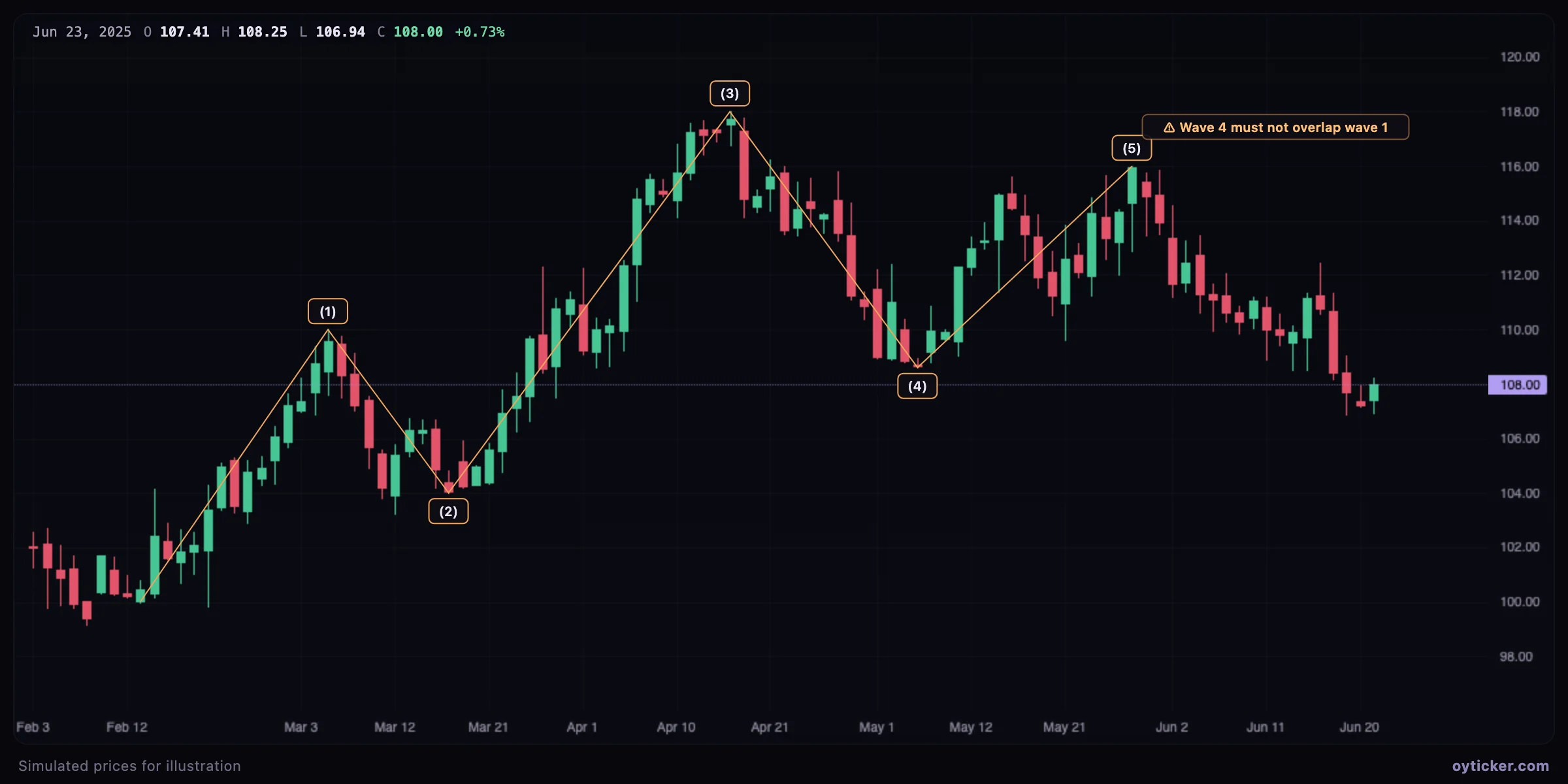
An invalid count is useful information: it removes one scenario. Elliott practitioners always keep an alternate count and a price level that would invalidate the preferred one.
How to draw it
- Choose Patterns → Elliott impulse (1-5).
- Click the start of wave 1, then the ends of waves 1, 2, 3, 4 and 5 on the swing highs and lows (the magnet helps).
- Read the message next to wave 5: either the rules are respected or the first broken rule is shown.
Limits
Wave counts are subjective and frequently revised in real time; only the three rules are objective. The tool checks rules, not whether the count is the right one.
Charts in this guide use simulated prices generated for illustration; levels and outcomes shown are examples, not observations of a real market. Educational content only, not investment advice.